Monday, March 3, 2014

Adaraba


I've always loved this prayer written by R'Elimelech of Lizhensk, one of the founding Rebbes of the Hasidic movement.  My translation of the prayer reads:

 God, rather, instill in our hearts the ability to see the positive attributes of our friends and not their faults. Let every person address his neighbor in a manner that is proper and desired by You. Let us not, God forbid, bear any hatred toward another individual. Strengthen us in our love towards You, as is apparent and known to You. God, let everything be pleasing before You. Amen, let it be Your will.

I translated the word Adaraba as "rather,"  which makes me wonder if there's a paragraph that precedes this well known prayer that says something along the lines of, "the baseless hatred that exists in our hearts is tearing our people apart.  Rather than this be our reality let us see the beauty in our fellow Jew and talk kindly to one another."


If there is no preceding paragraph maybe it was just R' Elimelech responding to the fighting going on between misnagdim and Chasidim.  Or perhaps it wasn't ideological fighting that R' Elimelech was referring to but rather a general call for Jews all over to not be petty and contentious but rather see the positive in each Jewish soul, love every Jew and use that love in the service of God.  Today, with all the different camps of Jews, protests and counter protests, maligning and name calling that sadly goes on within the Jewish world, I couldn't think of a more appropriate blessing and prayer to keep in the forefronts of our minds and hearts as we go about our day.  


What exists now doesn't have to be our reality...adaraba.  


Wednesday, October 16, 2013

The Beauty of Prints


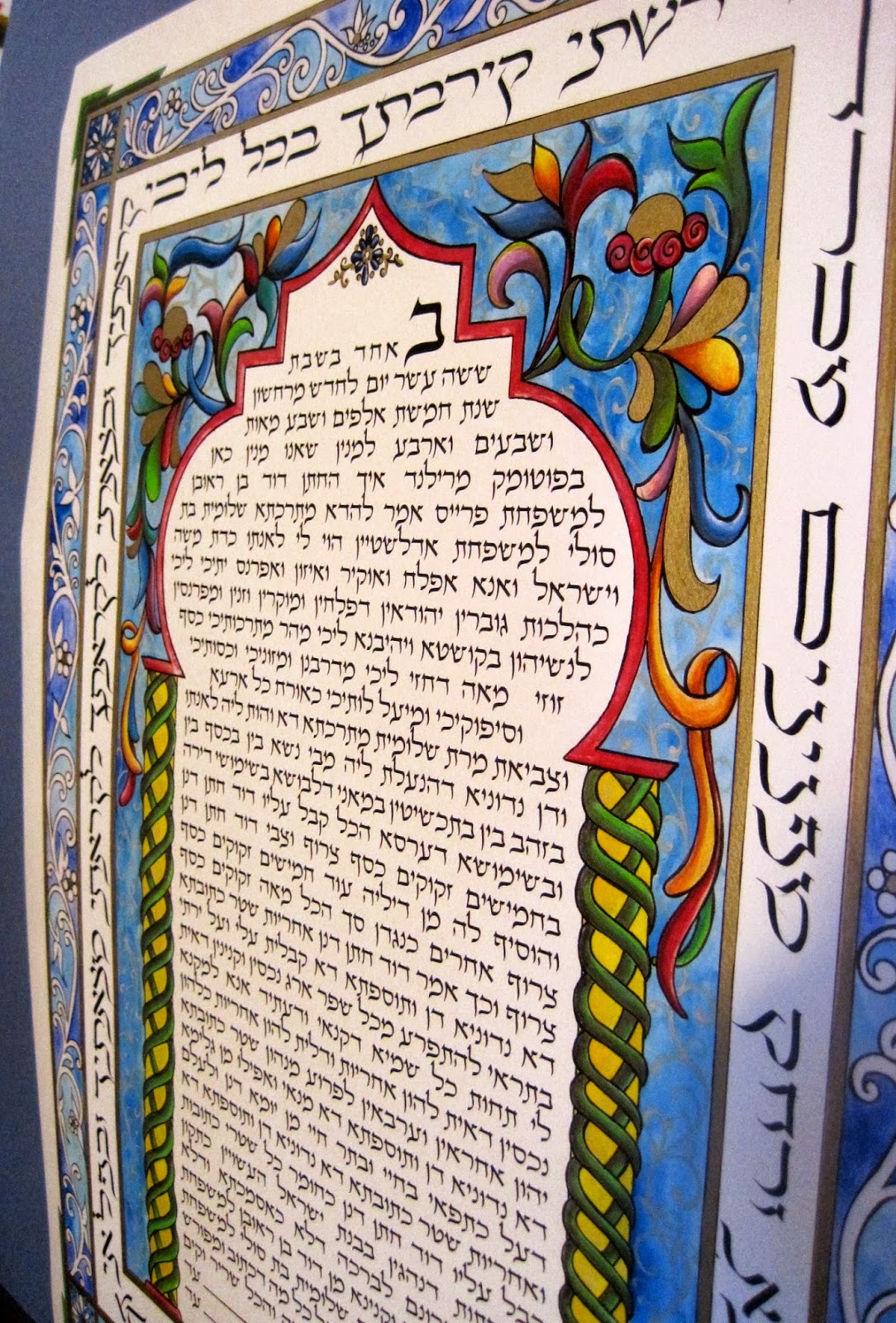
I created this ketubah last summer for a couple in California who wanted a special custom made ketubah with real Italian gold leaf applied.  They contacted me two months before their wedding and were happy to pay the price that comes with a custom ketubah.  I've started scanning a lot of my artwork because I often get e-mails such as "I love the Spanish Ketubah on your website, we're getting married in two weeks, can it be done by then?  Also I see it costs $1,050...if you make it a little smaller could you do it for $300?"  Or even people who realize the impossibility of that request just don't want to spend so much on their ketubah when weddings are already so costly.

I have two printing houses I work with, one in New York and one in Jerusalem and they do amazing jobs reproducing my artwork and making the originals into giclee prints.  They're so good, you really can't even tell the difference between the original and the print.  So a week ago I received an e-mail from a man getting married in two weeks and he was interested in the Spanish Gold Leaf Ketubah.  Once I received the information from him regarding the actual ketubah text my printers had it ready the next day.  I love modern technology!  Here is a picture of his ketubah:


The only thing I added by hand was the border text which is the first line of Eishet Chayil and a beautiful poem by Yehuda Halevy:
דרשתי קירבתך
בכל ליבי קראתיך

ובצאתי לקראתך
לקראתי מצאתיך

ובפלאי גבורתיך
קדש חזיתיך

Part of this poem appears on my ketubah as well!  So now when I get phone calls or e-mails asking if can have a ketubah ready by next week for a couple of hundred dollars I can happily say, "Yes!"

Thursday, February 21, 2013

The Divine Within


I entitled this piece, The Divine Within, as a play on the fact that the word "HaMelech" is encircled in several layers of design and pesukim from the books of Esther and Zecharya.  Through paralleling these two sefarim I wanted to highlight how to find the Divine within ourselves and others when God is hidden, just as He is in the Megillah.

I feel complimented that the Jewish Press chose to put this artwork on the front cover of their Purim issue.  Thank you Jewish Press!  Here is the article that accompanied the piece:


"Love Truth and Peace!”

Let's face it. How many of us really pay attention to the Megillah as it is being read? Unfortunately one of the side effects of learning these stories as children is that the level of understanding at which it was presented to us in our youth persists into adulthood and therefore our understanding remains unsophisticated. Due to an over-familiarity of the plot, the Megillah reading has an almost soporific effect and even the best intentions at concentration are often derailed as the significance and relevance of events that occurred over 2,000 years ago is lost on us year after year.

The Megilla is rife with allusions to other stories in Tanakh. One of my favorite aspects of studying Tanakh is noting word similarities between different passages and trying to understand the message conveyed through this textual interplay. Through my artwork I wanted to highlight a literary parallel that exists between the Megillah and a prohecy in Zecharya, whose message has always appealed to me on a moral and spiritual level.

In the book of Zecharya we are told of the following incident: The year is 355 BCE, King Acheshverosh of Megillah fame has died and Darius II, Esther's son has succeeded him. Two years into his reign, King Darius allows for the rebuilding of the Second Temple. In Darius's fourth year as king, a delegation of Jews arrives from Babylonia to ask a question of the prophets and kohanim in Jerusalem. Their question is as follows: Now that the Temple is being rebuilt is it still necessary to fast on the ninth of Av, the day the First Temple was destroyed 68 years prior? God reveals His answer through the prophet Zecharya who states that God Himself never decreed the fast days or various customs of mourning established by the Babylonian Exile. What God has declared through the mouthpiece of his prophets all the years leading up to the Babylonian exile is that His people “judge with truthful justice, and practice kindness and mercy to one another...speak the truth with one another, and judge in your gates with truth, justice and peace.”
The letter that is dispatched by Esther and Mordechai to all 127 provinces detailing the customs of the holiday of Purim and the Megillah is referred to as “divrei shalom v'emet - words of peace and truth.” The customs established on Purim; matanot l'evyonim, mishloach manot and feasting with family and friends were established as an antidote for the sins that had caused the Temple's destruction and subsequent exile. A significant portion of time is spent on Purim helping those in need, increasing feelings of brotherly love and rejoicing together as one nation. In the Megillah we are told how Esther and Mordechai hope that the hoilday of Purim will be kept for posterity just as the Jews have kept “tzomot v'za'akatam-fasts and cries” throughout their years in exile. Again an idea that parallels the prophecy in Zecharya when he says, “The fast of the fourth month (seventeenth of Tammuz), the fast of the fifth (ninth of Av), the fast of seventh (Tzom Gedaliah) and the fast of the tenth (tenth of Tevet) will be for joy and gladness to the House of Yehudah, and for happy festivals. Love truth and peace!” The message is clear, the road to redemption is paved with actions that are just and truthful and promote peace.

God's name does not appear in the Megillah. His absence is a punishment, alluded to in the name of the heroine, Esther, “v'anochi haster astir panai- and I will certainly hide my Face”. Our sins cause God to remove His presence from us. When God hides life becomes murky; we are left unprotected. The result is a national exile and a personal disconnect from the Divine. How do we fill that void? How do we go about convincing God we want a relationship with Him? Perhaps the answer is in the laws and customs of the Purim holiday. Fill the spiritual void in your life by finding the Divine in others. Turn fast days into festivals and mourning into joyous song by loving truth and peace.

Zecharya prophesizes how a spiritual revolution will sweep over the inhabitants of the world. Everyone will desire to ascend to Jerusalem to supplicate before God and seek out His presence. “In those days it will happen that ten men, from all the different nations, will take hold; they will take hold of the garment of an Ish Yehudi, saying Let us go with you for we have understood that God is with you.” The only other time in Tanakh the term Ish Yehudi is used is in the Megillah, describing Mordechai, “Ish Yehudi haya b'Shushan” a religious man, a leader, who himself was exiled to Babylonia shortly before God allowed His Temple to be destroyed. Mordechai realized the events that were transpiring were not happenstance but orchestrated by a God who although hidden was very much running the show. Mordechai is the Ish Yehudi described by Zecharaya, a man who serves as a beacon of spiritual strength and faith. Everyone recognizes God is with Mordechai. Along with Esther he establishes a holiday that will be celebrated even in messianic times. When all other holidays will be dissolved in the messianic era, Rambam tells us Purim will remain. Perhaps the reason for this phenomenon is as Rav Hutner explains, from the Purim experience we have learned to recognize God in the dark; and this skill once cultivated is never lost.

It is easy in our everyday lives to lose sight of God as our ego takes over, “V'anochi haster, astir” the “I” can easily hide God. However, if we work on recognizing God in the darkness of exile by loving truth and justice and acting benevelontly towards others it can have the effect of altering destiny, and filling the world with the light of God. This Purim may we all merit such brilliant clarity.

Monday, December 24, 2012

Mizrah

"Mimizrah, from the rising of the sun to its setting, the Lord's name is praised" (Psalms 113:3)


One of my first commissions when I started my business seven years ago was a painting entitled "City of Gold."  It was a cutout of Jerusalem's skyline painted gold with silver accents with Psalms 122 written in the center.  I made Jerusalem in a closed circle because of the third verse of that Psalm which states, "Jerusalem is built up like a city that is united together."


Over the years I recreated many versions of this piece with different texts written inside based on the customer's request.  The design has framed several ketubot as well.  Jerusalem was always painted in gold which is classy and lovely but secretly I kept hoping someone would order the piece and ask for Jerusalem to be painted in vibrant colors instead of the monochromatic gold.  When I have an urge to paint something I cannot rest until it's done, so one afternoon last May I decided to create a multi-colored Jerusalem.  I used gouache paint diluted with water so that the colors would run into one another and offer some nice shadings.  Two days later the painting was finished.  It was colorful and happy but the inside circle was blank and I wasn't sure what to write in that space.  The answer came to me later that summer when I was in of all places Jerusalem!  I decided the blank space would be filled with the word "Mizrah".

Mizrah, which is Hebrew for East, is a word often painted or carved out of wood or metal and hung in synagogues and homes on an eastern facing wall.  The Talmud (Berachot 30a) teaches us that one who stands in prayer outside of Israel should direct his heart eastward, toward Israel.  The first Biblical reference of facing eastward while praying is during the dedication ceremony of the newly built First Temple as King Solomon offers his heartfelt prayers to God (I Kings 8:22).  Another Biblical reference is in the Book of Daniel where the verses describe Daniel as having "...windows open in his upper story, facing Jerusalem, and three times a day he fell to his knees and prayed and gave thanks before his God" (Daniel 6:11). 

Many scholars believe that the idea of turning toward Jerusalem during prayer probably began during the Babylonian Exile following the destruction of the First Temple in 586 BCE.  Jerusalem was east of Babylonia and as verbal prayer became a substitute for animal sacrifice and communal synagogues replaced the Temple, facing East became a significant reminder to the exiled Jews of where the focus of their hearts should be albeit their physical bodies stood elsewhere on foreign soil.  Throughout the generations the most decorated wall of the synagogue has been the Eastern wall and until this day is the place where the Rabbi and prestigious members of the synagogue sit.

Our homes, meant to be mini sanctuaries and also places of worship, should have a wall decorated with the phrase Mizrah as a reminder of Jerusalem and where God once rested his Divine Presence among us.

This is the wall in my house where I pray, my personal reminder that in the comforts of my current home my real home lies elsewhere. 


(Oh yeah, and that's my Jerusalem painting hanging next to it...it wasn't intentional but the colors go really well together. I call this my "Jerusalem Wall," and it is my favorite space in my home!) 


Tuesday, October 16, 2012

The Glory of Gold


Anyone who follows my blog (namely my husband and my mom) knows that I love illuminated manuscripts. Much of my artwork is reinterpretations of well known medieval illuminated manuscripts. One of my favorite aspects of an old illuminated text is the gold leaf applied often to the first initial in the text and added into the details of the illuminated border.  An illuminated manuscript is not considered illuminated unless one or many of the illuminations contains gold foil or gold specks painted on it. In medieval times when illuminating texts was extremely popular, often (if not exclusively), the texts were of a religious nature so gilding them was a way of exalting the content within.  And even though they say diamonds are a girl's best friend, let's face it gold ain't too shabby either. In an effort for my artwork to have that authentic illuminated look, I would use several layers of gold paint to highlight different areas of the border. The gold paint looked nice and in a certain light practically glowed but alas I knew it was not the real thing.  For a while now I've been wanting to learn the art of gold leafing so my pieces could more authentically be described as illuminated artwork.

This past summer though I had the privilege of learning the art of gold leafing from an accomplished artist in Jerusalem who spends her days gilding the artwork of many well known artists in Israel as well as her own artwork.  The artist, Ronit, was so sweet and patient it was a pleasure learning from her.  Upon returning to my studio in NY, I had a ketubah order to complete and was so excited to implement my new skill of gold leafing.  Ironically the groom sells custom design furniture that is often gold leafed and asked that I use it in their ketubah.  (although as a sidenote the gold leaf used on furniture and the gold leaf used on paper/parchment is of a different nature.)

Here is my first gold leafing attempt, the enlarged initial letter "Bet" is made from 23 karat Italian gold.  I love the way the gold is raised and not flat like the paint used to be, it adds character and class to the artwork.


Here is the actual gold, you have to be so careful with this stuff if your finger touches the gold it will literally disintegrate, yet when applied to the glue base it lasts forever.  Pretty amazing.


Friday, July 20, 2012

Forever My Jerusalem


When I think of Jerusalem, I think of walking her quiet streets on Shabbat afternoon as I made my way from my home in Talpiot to visit my brother's family in Ramat Eshkol. I think of the stimulating Torah classes I took at Matan with brilliant teachers such as Dr. Aviva Zornberg and Dr. Mordecahi Sabbato; my own students at Machon Gold and Sha'alvim whose zest for learning and love for Eretz Yisrael reinforced my own. I think of the dance classes I took at Rachel Factor's dance studio, hip hop classes at the YMCA, Rosh Chodesh walks to the Kotel, and the beautiful melody of Lecha Dodi sung every Friday night at theYakar shul in the Katmon neighborhood. I think of Naomi, my 65 year old hippie art teacher at the Israel Museum, who would affectionately call me “Shira, Yafati, Tamati” a paraphrase from the book of Shir Hashirim. She was a secular Israeli but she was always quoting Rabbinic aphorisms and verses from Tanakh. I think of the hundreds of Shabbat meals and cups of cafe hafuchs I shared with friends, like minded olim, who left their formers lives and family to begin a new life in Israel. I think of marching through the streets on Yom Yerushlayim everybody dressed in blue and white waving Israeli flags spontaneously stopping to sing and dance, the joy in the air palpable. I think of my stepfather's kiddush on the first night of Sukkot several weeks after his first cousin and close friend Dr. David Applebaum was murdered, and the emotion that was felt as he reached the words “Blessed are You, Hashem our God, King of the universe, Who has kept us alive, sustained us and brought us to this season.” I think of the Friday afternoons spent delivering food packages to the poor and elderly; the soup kitchen on Rechov Agripas in which I volunteered, where gratitude and respect were always on the menu and the cook, like a mother, knew all the customers by name and told them what they needed to eat. I think of the warm Mediterranean sun beating down on me as I would walk to work, down Rechov Yehudah, up Koveshi Katamon and then a left on Chizkiyahu HaMelech, all the street names rich with Biblical and historical meaning; and I think of the delicious mountainous breeze that would set in, in the late afternoon and bring relief from the heat of the day. I think of my own wedding at Kibbutz Ramat Rachel, as I stood under the chuppah, a chorus of voices singing “Soon, let it be heard in the cities of Judah and the streets of Jerusalem the sound of joy and the sound of gladness, the voice of the groom and the voice of the bride...” as I looked out at family and friends, their faces framed by the hills of Jerusalem.

The colorful personalities of Jerusalem; the combination of spiritual, intellectual and creative energies that give Jerusalem her unique vibe, filled my own soul in a way that made me feel complete and whole- shalem. Yeru-shalem- a city that brought me much inner peace.

These are my thoughts of Jerusalem as my paintbrush dances across the canvas, creating a colorful depiction of what was once my home. This is my Jerusalem. Forever my Jerusalem. My heart and soul longs for the day I can return to you.


Wednesday, May 16, 2012

Wherever You Go There You Are


The title of this post is actually borrowed from a book I read a while ago by Jon Kabbat-Zin.  The book is about practicing mindfulness in our everyday life.  Mindfulness as defined by Zinn is a practice where "we commit fully in each moment to be present; inviting ourselves to interface with this moment in full awareness, with the intention to embody as best we can an orientation of calmness, mindfulness, and equanimity right here and right now.”  

The artwork above was commisioned by a woman as a gift for her husband upon his 40th birthday.  The wife knew what she wanted; a papercut mounted on a background painted in earth tones, an enlarged Hebrew letter "mem" and cut-outs of musical instruments since her husband is very musically talented.  And lastly, she wanted a verse from Sefer B'reishit "Ba'asher hu sham- in his present state." The last request puzzled me.  The verse is found in the story where Avraham Avinu sends Hagar and Yishmael away from his home.  The two wander in the desert of Be-er Sheva and when there is no longer water to drink and Yishmael is literally dying from thirst God hears Hagar's and Yishmael's cries of distress and an angel from heaven calls out to Hagar and says, "Fear not, for God has heeded the cry of the youth in his present state."   Even though the angels in heaven tried so to speak to dissuade God from saving Yishmael based on the evil his descendants would perpetrate against Bnei Yisrael, God doesn't listen to the angels pleas and saves Yishmael based on who he is at that moment in time.  Why, I thought would she want this verse included in the artwork?

The wife answered that her husband often likes to tell this story and quote this verse as a basis for living a mindful life.  As a practicing psychotherapist he tries to inspire his clients to live mindfully as well as practice it in his own personal life.  At first hesitant, now I was all for including the verse.  After all, probably most people on their birthdays, especially the milestone ones, spend the day (or perhaps even weeks leading up to it) obsessing over their lives thus far and fearing what is yet to come.  "Should've done this, should NOT have done that!"  All those regrets and thoughts of missed opportunities mixed with fears of aging and the future can cloud and ruin a day that is meant for celebration. 

 How nice is it to receive on your birthday a piece of artwork that serves as a visual reminder to quiet all that noise in your head and the chaos that so often surrounds us and instead calmly and serenely enjoy the best gift of all: being fully aware and present to the very moment in which you are currently in.


Monday, April 2, 2012

Let Them Eat Paint!

Ok, not really, unless it's the kind by Wilton with which you can decorate cookies.  But do let kids paint!  Or color...or bake...or create dinosaurs out of modeling clay or do anything that's fun and creative and yes, a little bit messy.  Letting kids paint on an 8x10 piece of construction paper is nice. Adding in a little glue and glitter is even better.  But, letting them paint the windows of your home is AWESOME!


And sometimes they might paint their bodies too... that's also cool. 


Being an artist it's not surprising that one of my favorite things to do with my children is artwork, and it's not just because I'm good at it or I have the patience for it, it's because I love that our artistic activities foster their creativity and imaginations.   And by letting things get a little bit messy they can relax and just be kids!  There's always so many rules by which they have to abide it's nice to just let go every once and a while and say "Guess what we're doing this afternoon? Painting on the walls!!!"


My son goes to the most amazing pre-school.  I'm obsessed with the place. Recently they started learning about Jackson Pollack (he's not even four and he can recognize a Pollack painting...sorry I'm a Jewish mother, I can't help myself).  If they raise enough funds after Pesach the teacher is buying each student a 2 x 3 ft canvas on which each child can create their own Pollack painting by drip painting it like Pollack did.  I love the idea of my son throwing paint on a canvas with abandon, allowing beauty to form from the freedom of letting a child do what he does best...making an awesome mess!

Wednesday, March 21, 2012

A Gift to Remember

Ok, who remembers who bought you your food processor?  Or which three friends chipped in for your Kitchen Aid? Your China? (Every setting is a different person to thank!)


But a piece of artwork specifically designed for your wedding with your monogram on it?! The givers of such a gift are not forgotten!


So how lucky is the couple who received the above piece for their wedding?  I know! (Granted once you have kids you will be eternally grateful for whoever it was that bought you that coffee maker...but you won't remember who it was...not even after your second cup...).


Speaking of which, I am now going to make myself some coffee...

Wednesday, February 29, 2012

Words of Peace and Truth


The picture above is of a piece I completed several months ago.  A woman ordered it as a birthday present for her husband whose mantra in life is "Shalom al Yisrael- Peace Unto Israel."  A nice refrain to live by and certainly this world would be a better place place if more people lived holding the banner of peace as their cause.

With Purim right around the corner I couldn't help but title this blog post with a phrase from the Book of Esther which also has to do with peace.  In the ninth chapter of the Book of Esther, we are told that Esther and Mordechai sent books to all 127 provinces of the King of Acheshveirosh, detailing the laws of Purim and the story of Esther.  The books were called "Words of Peace and Truth."  If there was ever a holiday whose commandments were meant to increase brotherly peace and a sense of community amongst the Jewish People, it was Purim.  We send baskets of food to our neighbors, give charity to those in need, eat a festive meal together with family and friends and drink a little liquor perhaps to mitigate any feelings of resentment or ill will we might be harboring toward our fellow Jew.

You see, the whole reason we were in Persia in the first place is because we had been kicked out of our land nearly 70 years prior to the story of Esther because we weren't able to get along with each other.  And one thing God really has no patience for is lack of peace between His children.  Esther who is a descendant of the tribe of Binyamin was willing to put her life on the line to save the Yehudim, descendants of the tribe of Yehuda.  This was a huge deal since for hundreds of years, going back to the time of the Judges, there was a lot of bad blood between the two tribes.  In fact the tribe of Binyamin was nearly wiped out in a civil war.  Oueen Esther's ultimate act of selflessness rectified a centuries old conflict that had been festering within the Jewish People.  To keep this feeling of brotherly love going and remembered for years to come the holiday of Purim was established with all it's peace promoting laws and customs established as "words of peace and truth."

And lastly, yesterday was 2/28, my oldest brother's birthday, whose name happens to be Binyamin Shalom...so peace unto you brother-man, and many, many happy years to come! And peace and happiness unto all as we celebrate this very meaningful holiday of Purim in one week's time.

Wednesday, November 30, 2011

"Sovev, Sovev"- Round and Round We Go


Last year while teaching Kohelet I came across a picture of a carpet page of a Bible from San'a, Yemen in 1469.  The shape of the triangle and inverted triangle with the circle in the center reminded me an hourglass sand clock.  Suddenly an idea started forming in my head.  The chapters of Kohelet would be written in concentric circles in the center of the piece and the Song of Time which begins, "Everything has its season, and there is a time for every desire under the heaven" would frame the piece fitting in perfectly with my original thought that the shape resembled an hourglass sand clock.  The result is the picture above, and below is a copy of the article I wrote for the Jewish Press several weeks ago.  The painting was on the front cover (!) and my op-ed piece followed several pages in:

“What a depressing book!” is often people's response to reading Sefer Kohelet. It seems at first glance that Shlomo Hamelech, the wisest of all men, is telling us there is no purpose to all of man's efforts whether it be in the intellectual, material or social arena. However this nihilistic view often erroneously attributed to Kohelet is not only antithetical to many Jewish beliefs taught by the Torah and our Rabbis it is even contradictory to statements Kohelet himself makes. What then is the message of Sefer Kohelet? Is there a way to spin Kohelet's oft-quoted statement “Hevel Havalim hakol hevel,” “Futility of futilities, all is futile” in a positive, perhaps even inspiring light?

The word hevel appears no less than thirty eight times in the sefer and if Shlomo Hamelech is telling us all is hevel, it is imperative to properly translate this word. When studying Tanakh and trying to define a word one needs to look at the first place that word appears and translate the word based on the context. The first place the word hevel appears is in the story in Bereishit of Kayin and Hevel. Hevel is the first person to introduce mortality into the world since he is the first human to die. Hevel is therefore defined as vanity or futility since his death teaches us that nothing lasts, all is fleeting, life is like the breath released from our bodies, non-tangible, transient. However there was more to Hevel's story, than his death; there was his life. In his life he achieved something wonderful and everlasting- a relationship with God. Through his sacrifice he was granted Divine deliverance, and “God turned favorably towards Hevel.” Although Hevel's death taught us life is not eternal, his life taught us how to gain transience in this world; through developing a relationship with God. The very fact that Kohelet tells us he has “witnessed all the deeds done under the sun, and indeed, all is futile and accomplishes nothing” is meant to inspire us to live life to the utmost by filling it with spiritual endeavors and God's Torah and mitzvot which are the only pursuits that have lasting value as opposed to everything else which in Kohelet's view is equivalent to “chasing winds.”
A couple of weeks ago I was at an amusement park with my family, enjoying the last few days of summer vacation. My three year old son wanted to go an a ride called, “Turtle Whirl.” Needles to say there was a lot of whirling and spinning going on on this ride. I could barely look at it without feeling slightly ill. My husband graciously agreed to accompany my son and I happily agreed to watch from the sidelines and take pictures. However, try as I may I wasn't able to get one single picture; the ride was spinning so fast it was impossible to capture their smiling faces. Isn't life the same. How often do we have days, maybe even weeks months or years where we literally feel like we are spinning around and around, it seems impossible to even pause long enough to catch one's breath, let alone stay focused and find meaning in it all. This idea is what inspired me to create the artwork “Sovev, sovev.” In the artwork, the majority of Sefer Kohelet is written in concentric circles, a dizzying feat in it of itself! As Kohelet teaches us, life and our daily activities are cyclical, just as nature is cyclical. The sun rises, the sun set; the wind blows from east to west, and then blows back again from west to east. As the Maharal teaches, human actions mirror nature. Even the words of Kohelet seem cyclical; Shlomo walking us through his logic and analysis of human endeavors just to bring us back to the same point, “Hakol hevel- all is futile.” The challenge is through this dizzying ride of life to find meaning and perspective.

The Avudraham explains that the words of Kohelet were culled from sermons given by Shlomo Hamelech every seven years on the holiday of Sukkot when the Jews would gather in Yerushalayim to celebrate the holiday and fulfill the mitzvah of hakhel (hence one of the reasons the book is called Kohelet). Every year on Sukkot we read Kohelet not to depress us rather to inspire us to not get swallowed up in the whirlwind of life but rather to remain focused that “The sum of the matter, when all has been considered: Fear God and keep his commandments, for that is the whole purpose of man.”
After all, if we are acutely aware that our time in this world is finite, how much more meaningful would our days be?


Wednesday, November 2, 2011

The Making of a Ketubah

I love watching an art piece develop. In truth I always have an idea of how the piece will turn out, but the end result is always a little different than I expected. It's a real creative process.  Normally I don't like anyone seeing my artwork before it's completely finished but I decided to give you, my readers, an inside peek of the process of designing a ketubah from scratch.

It starts with a sketch:
I draw with pencil a detailed sketch of the design.  Once the sketch is mainly completed I start filling it in with ink, pencil and watercolor, my usual choices of medium.  The couple who ordered this ketubah were getting married at the New York Botanical Gardens and they wanted a lot of detail of flowers and that blue should be the predominate color.  We decided to add in images of doves and olive branches as symbols of peace and harmony and pomegranates as a symbol of prosperity.  In addition, their wedding was right before Rosh Hashana so the pomegranates worked well with the time of year. (Also I love pomegranates so whenever I can add them into pieces I do!)

I finished adding in all the color for the flowers, now it's time to paint the background blue and fill in the corners.
If you notice I had an olive tree originally sketched into one of the corners, but I didn't like the way it looked.  A closer up of the olive branch would be more visually appealing and balance out the close-up of the pomegranates. (Art is all about balance, and if you don't believe me read Virginia Woolf's To the Lighthouse, one of my favorite novels of all time!)  I also decided to add an extra border of floral papercut around the perimeter to give it that little extra wow factor!  And as you can see I've started spacing out the ketubah text.  I always save that for last since it's my least favorite part of designing a ketubah!


The finished product!
And of course no artwork is complete without the artist's signature.

Thursday, October 27, 2011

It's All in the Family!


While creating the piece The Seven Species, I bumped into a woman in the supermarket who grew up around the corner from me in my hometown in NJ.  "I've been meaning to call you" she said.  I want to order a custom art piece for the Rabbi of my shul.  A couple of weeks ago was my son's Bar Mitzvah.  Everything was in order, we had 75 family members coming to us for Shabbos.  All our meals would be catered and eaten in the shul.  However, God had a different plan.  Thursday night there was a terrible rainstorm and the basement of the shul where we were supposed to have all our meals was flooded.  The Rabbi of the shul who has a huge living room graciously offered to host the meals at their home, and we want to give them a unique gift to show our appreciation for their helping us out.  How quickly could you have a piece ready?"

I couldn't help but laugh, the piece I was currently working on, The Seven Species was being made for this woman's brother-in-law who lives in Israel as a surprise gift for his 40th birthday.  I was told by the wife to keep the artwork a secret.  In my own family I was always known as the one who couldn't keep secrets.  I was about to shirk myself of that title.  I told my friend she would have to wait a couple of weeks because I was currently working on a piece for someone else, but I would let her know when it's complete.  "Ok, great" she said, "Oh and I want to keep the artwork a surprise from the Rabbi and his wife." She then told me their names and I realized I teach at the same school as the Rabbi's wife...more secrets to keep!


When The Seven Species were finished, I contacted my friend they told me they wanted a simple papercut with the words, "You can draw water with joy, from the springs of salvation."  The quote originally from Sefer Yeshayahu is recited during havdalah at the conclusion of Shabbos.  It was a perfect verse to use since it has to do with water (remember the flood that caused the whole scenario), Sabbath and God as the source of all Blessing.  The only thing they couldn't decide on was the color scheme.  My friend devised a plan that I could see the Rabbi's house when noone was home and choose the appropriate color for the piece.  This was going beyond keeping a secret, we're talking about breaking and entering here.  Anyway it was all accomplished, secrets were kept, I managed to get a peek inside their house without setting off any alarms and the result is the papercut above and below.  Hope you enjoyed my rambling story!

Monday, July 18, 2011

The Seven Species

I should write an ode to my neglected blog.  It's been way too long since I've paid any attention to you.  Perhaps now that it's summer and I have more free time I will be able to post more regularly.


Here is a piece I finished about two months ago  It is a papercut of Israel's seven species with the text of the Separation of Terumah and Tithes written in calligraphy on the inside.  I received a phone call from a woman in Jerusalem ( just read a book by A.B. Yehoshua with that exact title, but I digress...) who grew up around the corner from me in NJ, and has been living in Israel for the past 17 years.  Her husband enjoys working on his garden in their backyard in Jerusalem and taking the appropriate terumah from the fruits and vegetables that he grows.  To celebrate his upcoming fortieth birthday she wanted to know if I could write out the text of Separating the Terumah and Tithes and include in the piece a papercut of the seven species.  What a fun project!
 
I looked at many, many images of the seven species and sketched them out in pencil, then painted over the pencil in gold and cut out with an x-acto knife the negative space. 

Here we have some olives (excuse the shadow...a photographer I am not!)

some sheaves of wheat...

dates and figs.... 


          and pomegranates and barley


I was really happy with the way it came out.  I especially love how the gold glimmers in the light.  My husband liked this piece so much he asked if I could make it for our home.  My response? Buy an apartment in Jerusalem and plant a garden in the backyard and you'll get one too!

Monday, January 24, 2011

Fifty Years and Counting!


This family tree was created in honor of a couple who recently celebrated their 50th wedding anniversary.  Being that I've only been married 4 years I find that number quite impressive!
What was also impressive was the amount of effort, care, and concern the youngest child, who happens to be an old childhood friend, put in to making this gift happen.  It's not easy trying to get four other older siblings to agree on colors and design and every other detail that goes into creating a piece of artwork!  But they did it, and hopefully everyone will be pleased with the result.


The tree is made from canson paper, cut with a knife and mounted on a 20 x 24 in. canvas.  The canvas is painted with acrylic paint.

  
The writing is done in Indian ink and the edges are highlighted in gold paint.

 
Here's to another 50!  Mazal tov!